America’s carrier surge is rewriting the rules in the Middle East—because the U.S. military says Iran’s shooters are being taken out before they can fire.
Story Snapshot
- Operation Epic Fury has expanded into a large U.S. air-and-sea campaign aimed at degrading Iranian ships, missiles, and air defenses.
- U.S. Central Command leaders said the operation is ahead of plan, with thousands of targets struck and Iranian naval activity sharply reduced.
- Two U.S. carrier strike groups are operating in the region, with a third carrier potentially available, signaling sustained pressure and deterrence.
- Commercial tanker traffic through the Strait of Hormuz has dropped dramatically amid threats, raising risks for energy markets and U.S. allies.
Operation Epic Fury: What the Pentagon Says the Campaign Is Doing
U.S. officials describe Operation Epic Fury as a broad effort to dismantle Iranian military capabilities that threaten American forces and global shipping lanes. Department of Defense reporting has emphasized strikes on naval vessels, ballistic missile infrastructure, and air defenses, with U.S. Central Command leadership framing the mission around neutralizing systems that can attack U.S. personnel and partners. The available reporting does not provide complete casualty figures, and civilian harm assessments remain limited.
Admiral Brad Cooper’s briefings indicated a rapid tempo and large strike volume by early-to-mid March 2026, including claims of thousands of targets hit and dozens of ships struck. Cooper also described a major operational shift at sea, stating Iranian ships were no longer operating in key waters around the Persian Gulf and the Strait of Hormuz during the early phase of the campaign. Those claims are presented as U.S. military assessments; independent verification in public reporting is limited.
Why Aircraft Carriers Matter: Deterrence, Reach, and Political Signaling
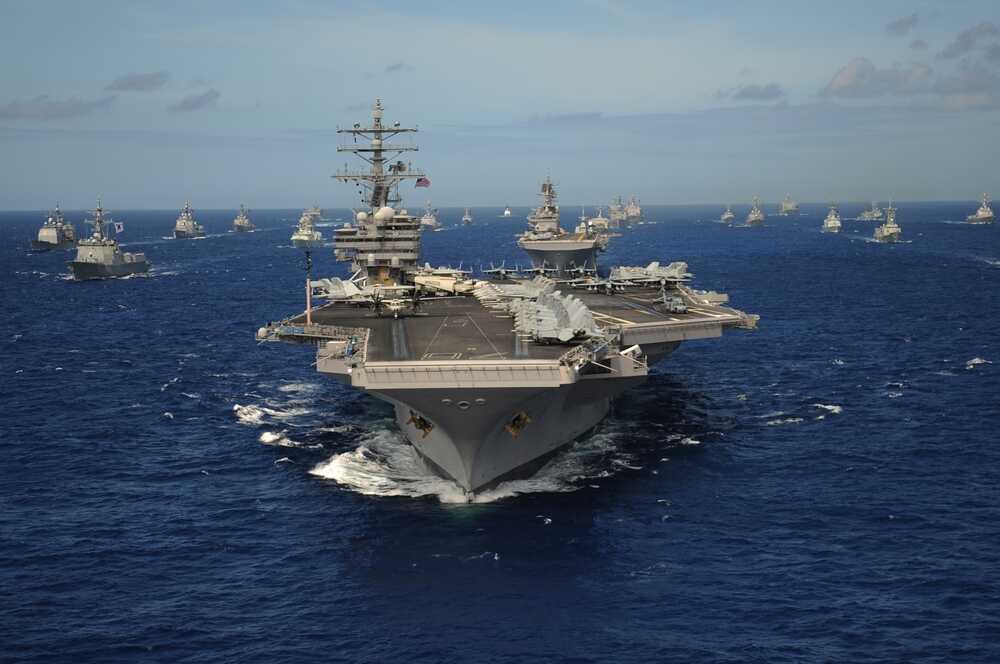
U.S. Navy carrier strike groups are more than floating runways; they are visible, sustained combat power that can be repositioned without relying on host-nation politics. Reporting indicates the USS Abraham Lincoln has operated from the Arabian Sea while the USS Gerald R. Ford has operated from the eastern Mediterranean, enabling air operations and layered defense. A third carrier, USS George H.W. Bush, has been described as prepared for possible deployment after completing workups.
Military analysis points to a buildup that looks designed for both offensive strikes and defense against retaliation, not merely symbolic “presence.” That distinction matters for Americans tired of unclear missions and endless halfway measures: a concentrated carrier posture suggests the administration is prioritizing freedom of navigation and credible deterrence over the previous era’s mixed messaging. At the same time, it acknowledges escalation risk if Iran’s leadership believes its regime survival is at stake.
Strait of Hormuz Pressure: Shipping Disruption and Energy Risks
The Strait of Hormuz remains the economic choke point hovering behind every operational update. U.S. reporting cited Iranian threats against tankers and described a dramatic decline in commercial transits during late February, a period when only minimal traffic reportedly moved through the strait. Because a significant share of global oil flows through that corridor, even short disruptions can ripple into price volatility, feeding the inflation pressures U.S. households have already endured.
President Trump also indicated the U.S. could escort tankers if necessary, a posture that aligns with the long-standing American interest in keeping critical sea lanes open. It does not provide a full plan for how escort operations would be scaled or how rules of engagement would be communicated to commercial shippers. What is clear is that the campaign is tied tightly to maritime security and the economic stakes of keeping energy moving.
What We Know—and What’s Still Unclear—About Iranian Retaliation
U.S. briefings say Iranian drone and missile attacks have “drastically dropped,” implying the strikes have reduced Iran’s ability to sustain pressure. It also warns that Iran retains asymmetric options, and that escalation pathways exist beyond drones and cruise missiles if Tehran feels cornered. Public details remain incomplete on Iran’s remaining mobile missile launchers, the condition of its defense industrial base, and the scope of any covert or proxy responses.
Supercarrier Surge: Why a Fleet of U.S. Navy Aircraft Carriers Could Soon Be Striking Iranhttps://t.co/8jGFP4ONd0
— 19FortyFive (@19_forty_five) March 12, 2026
Conflicting narratives also persist. It notes a dispute over a downed Iranian drone, with Iranian state media describing a benign surveillance mission while U.S. Central Command viewed it as a potential threat. That gap is typical in fast-moving conflicts, and it underscores why Americans should separate confirmed operational statements from wartime messaging. For now, the strongest documented claims come from U.S. military briefings and defense-focused reporting, not from independent on-the-ground verification.
Sources:
Stars and Stripes: Iran navy, Cooper, ships, ballistic missiles (March 4, 2026)