

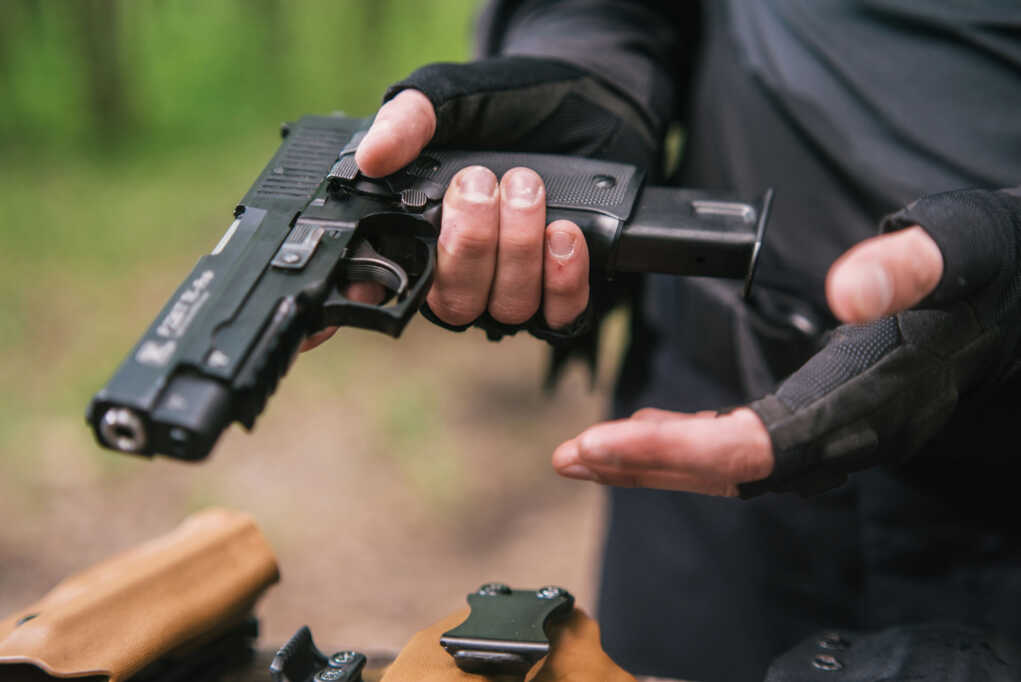
A Venezuelan national paroled into the U.S. was charged after allegedly yanking a federal agent’s loaded Glock from its holster during an arrest in suburban Detroit.
Quick Take
- Federal prosecutors say Arnoldo Jose Marquez-Pulido, 33, assaulted an HSI task force agent and briefly possessed the agent’s firearm while resisting arrest in Utica, Michigan.
- The incident began during surveillance tied to tips that a local business was using illegal aliens as delivery drivers, then escalated into a vehicle-and-foot chase.
- The DOJ is pursuing pretrial detention as the case moves from a criminal complaint toward potential grand jury indictment.
- The case is being publicly linked to “Operation Take Back America,” reflecting the administration’s broader push for interior enforcement and officer safety.
What happened in Utica, Michigan—and what prosecutors are alleging
Federal authorities in the Eastern District of Michigan say Homeland Security Task Force agents tried to stop Marquez-Pulido after observing his vehicle during surveillance of a Utica business. Investigators had received information that the business employed illegal aliens as delivery drivers. According to the criminal complaint, the suspect fled first by vehicle, returned to the business, then ran on foot. During the struggle, prosecutors allege he struck an agent and grabbed the agent’s holstered Glock 19.
Prosecutors say the firearm was briefly removed and wielded before agents subdued him with additional help. The complaint describes injuries to two agents: one suffered contusions and abrasions to the face and elbow area, while another suffered a knee contusion; both were treated and released. The government has emphasized that these are allegations at the charging stage and that the defendant is presumed innocent unless proven guilty, with the next major procedural step being grand jury action.
How parole and interior enforcement collide in real life
Authorities say Marquez-Pulido arrived at the San Ysidro port of entry in April 2024 without valid entry documents and was paroled into the United States. That timeline matters because parole decisions often become abstract talking points until they intersect with a criminal docket and an injured officer. In this case, the alleged violence was not described as a border encounter; it occurred during an interior operation in Michigan focused on employment and immigration violations.
The investigation also highlights why worksite-related leads still drive enforcement far from the border. Tips about unauthorized workers functioning as delivery drivers—paired with surveillance—triggered a routine stop that quickly escalated into flight and physical resistance. For Americans who want lawful immigration and predictable rules, the practical question is whether parole and release policies created enforcement backlogs that push risky encounters into neighborhoods, parking lots, and workplaces rather than resolving cases promptly.
Operation Take Back America: messaging, deterrence, and limits of the record
The U.S. Attorney’s Office framed the case as rebuttal to claims that illegal aliens are “harmless,” tying the prosecution to “Operation Take Back America,” a DOJ initiative aimed at illegal immigration, cartels, and violent crime involving illegal aliens. That framing serves a clear political and operational purpose: emphasizing officer safety and deterrence while signaling that interior enforcement is a priority under current federal leadership. The available record, however, remains narrow because it relies on a complaint, not trial-tested evidence.
A pattern of resistance cases—and why details matter for public trust
Other DOJ announcements in recent years describe similar “resisting” scenarios that turn into federal assault cases, including an illegal alien sentenced in Georgia after an ICE-officer assault tied to arson and reentry, and another case in South Texas involving an assault on a federal agent followed by flight. Those prior prosecutions don’t prove any single defendant’s guilt in Michigan, but they do show why federal agencies treat resistance as a high-risk moment where a routine encounter can become life-threatening.
Illegal Alien Charged With Assaulting Federal Officer https://t.co/j2uTdNuUnU
— Tom O’Reilly (@interactivleads) April 15, 2026
For the public, the credibility test is simple: enforce the law consistently, protect officers, and avoid narratives that overreach what the evidence can support. This case will now hinge on what investigators can prove beyond the complaint—especially regarding the firearm possession and the sequence of force used by both sides. If prosecutors secure detention and later an indictment, the case will become another data point in the ongoing national debate over parole policies, workplace enforcement, and whether the federal system is actually preventing predictable risks.
Sources:
Illegal Alien Sentenced for Assaulting Federal Officer and Setting Apartment Building Fire
Illegal Alien Guilty to Assaulting Federal Agent and Fleeing the Scene in Underwear