
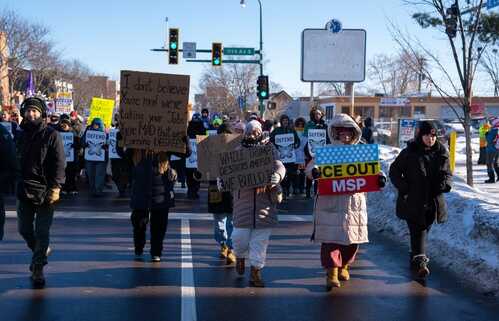
Anti-ICE anger in Minneapolis exploded after a federal immigration enforcement operation ended with an ICE agent fatally shooting 37-year-old Renee Nicole Good in the city’s downtown core. While federal officials state Good attempted to use her vehicle as a weapon, local activists and officials dispute that account, immediately demanding an independent probe and turning the incident into a rallying point against immigration enforcement itself. The resulting protests turned destructive, leading to dozens of arrests, property damage, and an injured police officer, all while a separate conflict unfolds between state and federal agencies over access to evidence.
Story Highlights
- Anti-ICE protests in Minneapolis turned destructive, leading to at least 29 arrests or citations and one injured police officer.
- The unrest followed the fatal shooting of 37-year-old Renee Nicole Good by an ICE agent during a downtown enforcement operation.
- State and federal agencies are clashing over access to evidence, with Minnesota’s Bureau of Criminal Apprehension pulling out of the investigation.
- Activists used the incident to escalate long-running efforts to weaken immigration enforcement and pressure local police.
How A Federal ICE Operation Sparked Days Of Turmoil
Anti-ICE anger in Minneapolis exploded after a federal immigration enforcement operation ended with an ICE agent fatally shooting 37-year-old Renee Nicole Good in the city’s downtown core. Federal officials state that Good attempted to use her vehicle as a weapon, driving toward agents and forcing one to fire. Local activists and some Minnesota officials dispute that account, immediately demanding an independent probe and turning the incident into a rallying point against immigration enforcement itself.
Within hours of the shooting becoming public, crowds grew from hundreds to thousands, converging on key downtown sites tied to the operation. Demonstrators marched near the original shooting scene and massed outside the Canopy by Hilton hotel, where they believed ICE agents were staying. Protesters blocked streets and light-rail tracks, set up tents, and built makeshift encampments, turning buscay commercial corridors into staging grounds for unrest that strained already thin local law enforcement resources.
#US ICE agents storm homes in Minneapolis, detaining families amid ongoing outrage over the killing of Renée Good. Videos show doors kicked in and aggressive raids. Critics call this escalation, not law enforcement, as communities reel from fear and anger. Video @allenanalysis pic.twitter.com/c6FKugXvnQ
— The South Asia Times (@thesouthasiatim) January 11, 2026
From “Protest” To Property Damage, Threats, And An Injured Officer
Authorities initially tolerated demonstrations while they remained peaceful, but the situation shifted when segments of the crowd turned confrontational. Police reported broken windows, graffiti, and other property damage near downtown buildings, prompting Minneapolis police, the Minnesota State Patrol, and Department of Natural Resources officers to declare an unlawful assembly. As dispersal orders went out, some protesters responded not with dialogue but with aggression, surrounding vehicles, hurling snow and ice, and shouting explicit threats at officers and federal agents.
In the most concrete sign of that escalation, one Minneapolis police officer suffered minor injuries after being struck by a thrown chunk of ice. The injury, while not life-threatening, underscored how quickly a supposedly peaceful protest can tip into targeted attacks on law enforcement. Officers ultimately arrested or cited at least 29 people, largely for unlawful assembly and related offenses, before releasing most of them. The pattern will be familiar to many readers: radicals push the line, property gets damaged, police finally intervene, and the accountability largely stops at low-level charges.
Evidence Battles And The Federal–State Power Struggle
Behind the street scenes, a quieter but equally consequential fight is unfolding over who controls the facts of the shooting. In Minnesota, the Bureau of Criminal Apprehension typically leads independent investigations when officers use deadly force, providing citizens some assurance that incidents will not simply be handled in-house. In this case, however, the BCA announced it had “reluctantly withdrawn” from the probe, saying the FBI would not provide the evidence it needed to conduct a credible, independent review.
That move leaves the federal government largely investigating itself, even as activists and some state officials publicly challenge the Department of Homeland Security’s self-defense narrative. Federal agencies, including DHS and ICE, point to a broader surge in suspects weaponizing vehicles against officers and insist the agent responded to a real threat. Critics argue that without full transparency, especially video and forensic material, the public cannot fairly assess whether lethal force was justified. For constitutional conservatives, the clash raises serious questions about due process, separation of powers, and the danger of unaccountable federal policing in American cities.
What These Protests Reveal About The New Immigration Landscape
The Minneapolis unrest is not happening in a vacuum. After years of Biden-era drift, President Trump’s return to office has refocused Washington on immigration enforcement, border security, and cooperation between federal and local authorities. ICE, DHS, and allied agencies are again central players, tasked with reversing years of laxity, mass releases, and half-hearted interior enforcement that fueled public frustration over illegal immigration, crime, and fiscal strain. That renewed emphasis naturally collides with activist networks built up since 2020 to resist nearly any form of enforcement.
On the ground in Minneapolis, that larger fight plays out as pressure on local leaders to distance themselves from ICE while still maintaining basic order. The city remains a symbol of protest politics after the George Floyd riots, and every major demonstration becomes a test of whether leaders will stand with law-abiding residents or indulge activists who treat vandalism and assaults as acceptable “expression.” For many conservatives, the images are a reminder of why strong borders, clear laws, and firm but accountable policing are essential to preserving community safety and constitutional government.
Watch the report: Protests held across South Florida after deadly ICE shooting of mother of 3 in Minneapolis
Sources:
- Dozens arrested and one police officer injured in Minneapolis protests
- Minneapolis ICE shooting live coverage and protest updates
- ICE protest in Minneapolis after deadly shooting of Renee Good
- Dozens arrested and one police officer injured during Minneapolis ICE protests
- Minneapolis ICE protest sees property damage and officer injury near Canopy hotel and Depot