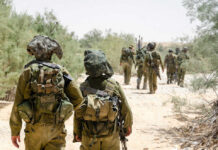
President Trump just refused to rule out U.S. ground troops in Iran—an escalation question that could redefine the mission, the timeline, and the cost.
Quick Take
- Trump said he would consider “boots on the ground” in Iran “if necessary” as Operation Epic Fury continues.
- The Pentagon also declined to rule out ground troops, while military leaders signaled the campaign could be prolonged.
- Public timelines have varied from “two or three days” to “four weeks,” adding uncertainty for Americans tracking the operation.
- Casualty figures cited in reports exceed 555 killed in Iran, alongside deaths in Israel, Lebanon, and among U.S. service members.
Trump’s “If Necessary” Message Puts Ground Troops Back on the Table
President Donald Trump told the New York Post he would not rule out deploying U.S. ground troops to Iran, saying he would do it “if necessary” and that he doesn’t have “yips with respect to boots on the ground.” The remark landed as Operation Epic Fury—described as a U.S.-Israeli campaign—continues striking Iranian leadership and infrastructure. Defense Secretary Pete Hegseth echoed that posture by refusing to publicly rule out ground forces during a Pentagon briefing.
Trump’s posture contrasts with the political caution Americans grew used to during years of carefully limited engagements that still dragged on. At the same time, it does not establish a decision to send ground troops—only that the administration is keeping the option open. That distinction matters because “not ruling out” is not the same as ordering a deployment, yet it signals to Iran that Washington is prepared to raise pressure if objectives cannot be met from the air.
Operation Epic Fury’s Timeline Keeps Shifting, and the Public Notices
Operation Epic Fury was announced early Saturday from Mar-a-Lago as “major combat operations,” accompanied by calls for Iranian forces to surrender. Since then, the public timeline has moved around. Trump suggested to Axios the campaign might end in “two or three days,” then told the Daily Mail it was a “four-week process,” and later, at a White House Medal of Honor ceremony, described a four-to-five-week timeline that could extend. Gen. Dan Caine described the campaign as difficult, “gritty work,” and not overnight.
Those shifting estimates can be read two ways based on the limited facts available: either planners are adapting to conditions on the ground, or public messaging is balancing operational security with political expectations. What is clear is that unclear timelines create room for rumor, panic, and media spin—especially after years when Americans watched Washington overpromise and underdeliver abroad. The administration’s challenge is to keep Americans informed without boxing commanders into a calendar that Iran can exploit.
Casualties and Retaliation Raise the Stakes for Any Escalation Decision
Reports cited in the research place deaths in Iran above 555, including more than 100 children, along with 31 deaths in Lebanon, 11 in Israel, and six U.S. service members. It ties the campaign to rapid strikes against Iranian leadership, including the killing of Iran’s Supreme Leader Ayatollah Ali Khamenei in an initial wave. Some casualty figures are attributed to Iranian media and the Red Crescent and are not independently verified within the provided materials, but they frame the scale of the conflict.
Retaliation is already part of the picture. Iranian strikes reportedly hit U.S. and allied interests, and the operation is described as targeting missiles, naval forces, nuclear infrastructure, and proxy networks. For a conservative audience that values strong national defense without endless nation-building, the key question becomes practical: what level of force ends the threat, and what level of force risks widening the war. It supports that leadership views the campaign as ongoing and potentially extended, not a quick, clean end.
Conflicting Signals: Open-Ended Options vs. “Not Part of the Plan”
Another complication is messaging discipline inside the government. While Trump and Hegseth publicly left the ground-troop option open, also cites a White House dismissal of some troop reports as “not part of the plan,” even as Trump discussed the possibility elsewhere. That kind of split-screen communication is familiar to Americans after years of bureaucratic hedging, and it can undercut deterrence by making U.S. intentions look uncertain even when capability is overwhelming.
On substance, the administration’s stated goals focus on preventing Iran from obtaining a nuclear weapon and degrading the regime’s capacity to project violence through missiles, naval forces, and proxies. Supportive commentary cited from the Heritage Foundation argues Trump prepared carefully and that Iran is weakened. Still, the available sources do not provide detailed benchmarks for what “success” looks like day to day, which is exactly why “ground troops” becomes such a charged phrase in American politics.
Sources:
Trump Says He Would Deploy Ground Troops to Iran “If Necessary”
Trump full statement on US Iran attack, major combat operations
‘Not Part of the Plan’: White House Dismisses Iran Ground Troop Report