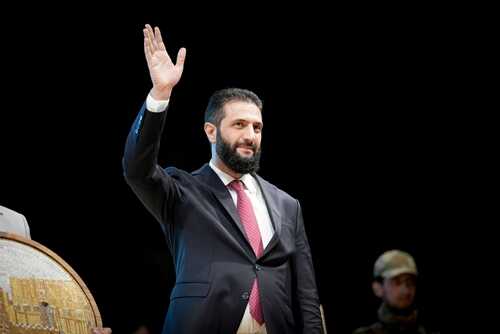
Russia’s strategic pivot in Syria exposes the fragility of foreign entanglements as Vladimir Putin courts the new Damascus leadership under interim President Ahmed al-Sharaa while simultaneously withdrawing forces. This move mirrors President Trump’s “America First” drawdown, a shift that prioritizes national interests over endless Middle Eastern commitments. The coordinated, pragmatic realignment by both powers signals a fundamental reshaping of the region’s power dynamics, but leaves the future of critical Russian military bases uncertain and complicates relations as Sharaa demands the extradition of the ousted Bashar al-Assad.
Story Highlights
- Putin met Syria’s interim President Ahmed al-Sharaa on January 28, 2026, seeking to preserve Russian military bases after backing ousted dictator Assad.
- Russian forces withdrew from Qamishli airport in Syria’s Kurdish-controlled northeast, signaling non-interference in Syria’s territorial unification efforts.
- President Trump spoke with Sharaa the same day about maintaining ceasefire with US-backed Kurdish forces as America pursues its own drawdown.
- Russia’s Hmeimim airbase and Tartus naval base remain uncertain as Sharaa demands extradition of Assad, whom Putin granted asylum in Moscow.
Russia Adapts to Post-Assad Syria
Vladimir Putin hosted Syria’s interim President Ahmed al-Sharaa at the Kremlin on January 28, 2026, marking a dramatic shift from Russia’s decade-long support of Bashar al-Assad. The meeting focused on restoring bilateral relations and Syria’s territorial integrity while addressing the future of Russian military installations. Putin praised Sharaa’s unity efforts and congratulated him on territorial gains against Kurdish forces. This represents Moscow’s second engagement with Sharaa since rebel forces ousted Assad in 2024, forcing Russia to recalibrate its Middle Eastern strategy after investing heavily in propping up the former dictator’s regime.
🇷🇺 🇸🇾 Russian President Vladimir Putin hosts Syrian President Ahmad al-Sharaa at the Kremlin.
Putin said that Moscow and Damascus have managed to break the stalemate in economic cooperation, the progress is noticeable, and it's important to maintain this trend. pic.twitter.com/YZRw01JHE2
— Lenka White (@white_lenka) January 28, 2026
Strategic Base Preservation Amid Withdrawals
Russia withdrew forces from Qamishli airport in Syria’s Kurdish-controlled northeast earlier in January 2026, a move Syrian officials interpreted as goodwill to avoid entanglement in Damascus’s offensive against US-backed Syrian Democratic Forces. Kremlin spokesman Dmitry Peskov confirmed that discussions about Hmeimim airbase and Tartus naval base—Russia’s only military facilities outside former Soviet states—were “no doubt” held during the Putin-Sharaa summit. These Mediterranean installations provide critical power projection capabilities for Moscow, making their retention vital despite the collapse of Russia’s Assad partnership. The bases represent significant Russian investment since intervening in Syria’s civil war in 2015.
Trump Pursues Parallel American Interests
President Trump spoke with Sharaa hours before the Kremlin meeting, focusing on maintaining ceasefire agreements with Kurdish-led SDF forces in eastern Syria. The Trump administration has prioritized transferring ISIS detainees to Iraq while pursuing a broader drawdown of American forces—a sensible approach that avoids the nation-building disasters of previous administrations. This America First strategy recognizes that endless Middle Eastern commitments drain resources without serving core national security interests. Unlike the Biden-Obama playbook of unlimited foreign entanglements, Trump’s engagement with Sharaa demonstrates pragmatic diplomacy that protects specific American concerns while avoiding the quagmire mentality that characterized leftist foreign policy failures.
Geopolitical Realignment Challenges Regional Order
The simultaneous Russian and American withdrawals from northern Syria signal a fundamental reshaping of Middle Eastern power dynamics. Sharaa’s government balances relations with Moscow, Washington, and Ankara while demanding Assad’s extradition—a request that complicates Russian-Syrian relations since Putin granted the ousted dictator asylum. Kurdish SDF forces face increasing pressure from Syrian government offensives despite American support, highlighting the limitations of proxy relationships. Russia’s pragmatic shift from backing Assad to engaging Sharaa demonstrates Moscow’s adaptability in maintaining influence, though the outcome remains uncertain. This complex realignment offers opportunities for reduced American exposure in a region that has consumed enormous national resources with questionable returns for ordinary Americans.
The coordinated withdrawals by both powers suggest a mutual recognition that Syria’s internal consolidation serves neither nation’s interest to obstruct directly. For American conservatives, Trump’s measured approach—engaging diplomatically while reducing military footprint—represents the foreign policy restraint that voters demanded after decades of costly interventions. Russia’s base negotiations and troop movements reveal Moscow’s weakened position following Assad’s collapse, a reminder that authoritarian client states make unreliable partners. As Syria’s future unfolds under Sharaa’s transitional government, American interests remain best served by limited engagement focused on counterterrorism rather than the endless commitments that drained taxpayer dollars and military resources under previous administrations.
Watch the report: Putin congratulates al-Sharaa on his efforts to unify Syrian territory
Sources:
- Putin Meets With Syrian President at Kremlin Amid Uncertainty Over Russian Bases – The Moscow Times
- Russia Withdraws from Syria’s Qamishli Amid Talks With New Leadership – The Jerusalem Post
- Putin, Still Harboring Assad, Welcomes New Syrian Leader to Moscow Again
- Syrian president arrives in Moscow for talks with Putin