
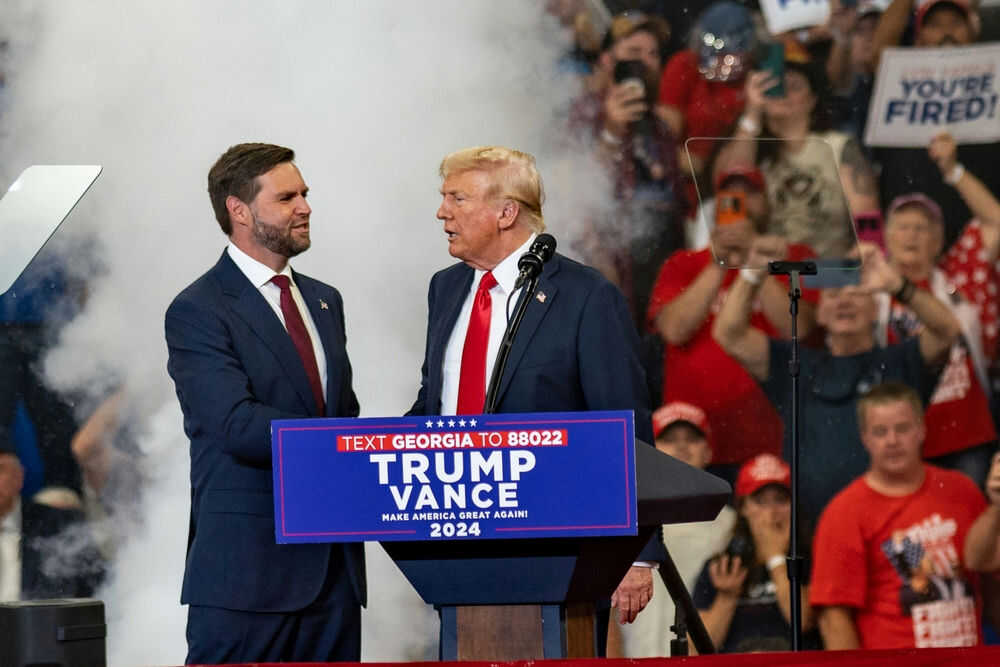
Vice President JD Vance’s path to the 2028 Republican presidential nomination faces an unexpected threat from his perceived association with Tucker Carlson, whose approval among GOP voters has collapsed to toxic levels.
Story Snapshot
- Vance leads 2028 GOP field with 74% approval, but Tucker Carlson’s plummeting favorability—down to 17% overall and 41% among Republicans—creates a vulnerability for the Vice President
- Recent polling shows Vance dropping 8 points to 53% at CPAC while rival Marco Rubio surged 32 points to 35%, signaling shifting momentum in the 2028 race
- Trump’s April 9 Truth Social attack on Carlson deepened the media figure’s GOP favorability collapse, dropping his net favorable rating 47 points
- Political analysts warn challengers could weaponize Vance’s silence on Carlson’s Trump criticisms through guilt-by-association tactics to erode his frontrunner status
Carlson’s Toxic Approval Numbers Create Vance Liability
Tucker Carlson’s standing among Republican voters has experienced a dramatic freefall, according to recent polling data. A UMass Lowell/YouGov poll from March 30 showed Carlson at just 17% overall approval, while a JL Partners/Daily Mail survey in early April revealed his GOP approval dropped to 41%, a 10-point decline in one month. CNN analyst Harry Enten characterized Carlson as being “in free fall among GOP” voters, with his net favorable rating crashing 47 points. This collapse creates a political hazard for Vance, who maintains perceived ties to the controversial media figure despite offering no public statements addressing Carlson’s ongoing criticisms of President Trump.
Strategic Silence Proves Double-Edged for Vice President
Vance’s refusal to address Carlson’s attacks on Trump represents a calculated political gamble that could backfire as 2028 approaches. While the Vice President maintains strong 74% GOP approval—second only to Trump’s 77%—his silence allows rival campaigns to construct narratives portraying him as either morally weak or secretly aligned with Carlson’s anti-Trump positions. Other prominent Republicans like Ted Cruz have publicly denounced Carlson, creating contrast that challengers could exploit. Political operatives note this vulnerability becomes particularly acute given Vance’s role as Trump’s heir apparent, where absolute loyalty to the President remains the litmus test for MAGA grassroots voters who increasingly view Carlson as a traitor to the movement.
Rubio Gains Ground as 2028 Field Takes Shape
Secretary of State Marco Rubio has emerged as Vance’s primary challenger, capitalizing on recent momentum that saw his CPAC support skyrocket from just 3% to 35% while Vance dropped from 61% to 53%. The dramatic shift reflects Rubio’s successful leveraging of his foreign policy credentials and donor network cultivation, highlighted by both candidates’ attendance at secretive high-dollar fundraising events. At an April Nashville gathering organized by the Rockbridge Network—requiring $100,000 contributions—Vance emphasized the 2026 midterms and anti-fraud efforts while avoiding direct 2028 discussion. Trump aide James Blair reinforced the administration’s focus on midterm victories over presidential positioning, though the maneuvering clearly signals an intensifying succession battle within Trump’s inner circle.
Deep State Dynamics and Grassroots Frustration
The Vance-Carlson controversy exemplifies broader voter frustrations with political elites prioritizing personal advancement over principled leadership. Many Americans—across both conservative and liberal spectrums—increasingly believe Washington insiders manipulate narratives and relationships to maintain power rather than addressing the economic struggles facing working families. Vance’s strategic calculation to avoid the Carlson question, while potentially savvy for party unity, reinforces perceptions that political figures carefully choreograph positions based on polling rather than genuine conviction. This dynamic particularly resonates with voters who supported Trump precisely because he appeared willing to challenge establishment norms, making Vance’s careful silence a potential liability among the very base he needs to energize for a successful 2028 campaign.
The 2028 Republican primary remains fluid with Trump refusing to offer early endorsements, prioritizing instead the 2026 midterm elections as the immediate test of MAGA durability. Whether Vance’s frontrunner status withstands scrutiny over his Carlson associations—or whether rivals like Rubio successfully exploit this perceived weakness—will likely determine the future direction of the Republican Party in the post-Trump era. For now, the Vice President walks a tightrope between maintaining party unity through silence and defending his loyalty credentials against inevitable attacks that his refusal to denounce Carlson represents moral cowardice or hidden sympathy for Trump’s critics.
Sources:
2028 Palace Intrigue: Republican Challengers Have Discovered JD Vance’s Kryptonite. It Is…
Vance Spotted at Secret Donors Meeting as 2028 Rival Surges
Rubio-Vance 2028 Republican Nominee