
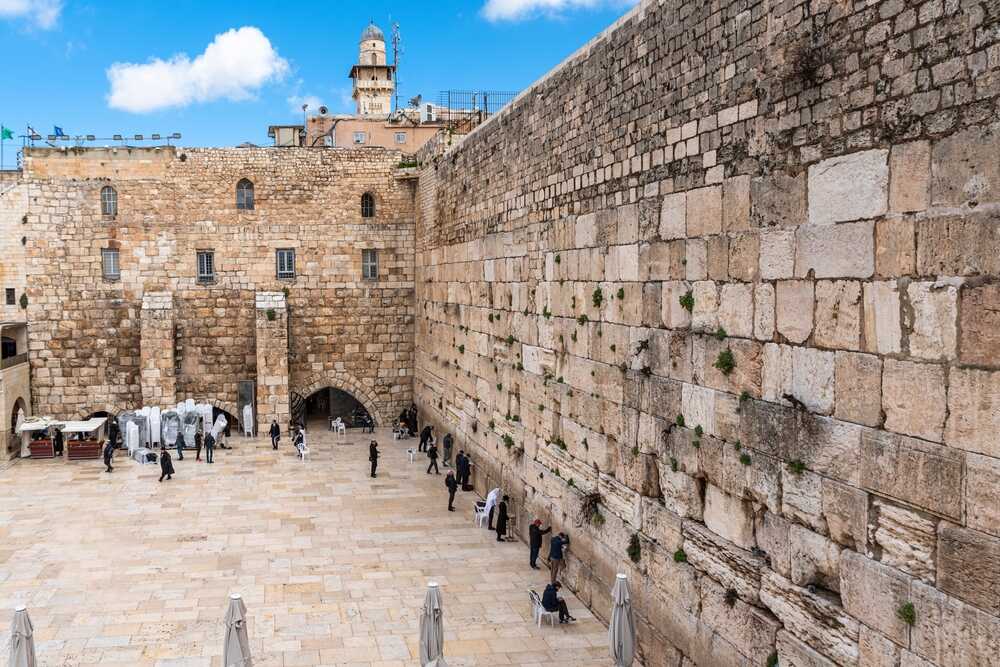
Israel’s lawmakers just advanced a bill that could turn certain forms of prayer at the Western Wall into a felony-level “desecration” offense—punishable by up to seven years in prison.
At a Glance
- Israel’s Knesset passed a preliminary reading (56–47) of a bill expanding Orthodox Chief Rabbinate authority over prayer arrangements at all sections of the Western Wall, including the egalitarian area.
- The measure amends Israel’s 1967 Protection of Holy Places Law and defines non-compliant practices, including mixed-gender prayer, as “desecration.”
- The bill directly collides with a recent High Court ruling ordering progress on long-stalled upgrades to the egalitarian Ezrat Yisrael plaza.
- Prime Minister Benjamin Netanyahu did not formally endorse the bill and reportedly avoided a government-committee vote, but coalition lawmakers advanced it anyway.
What the Knesset advanced—and why it matters
Israel’s Knesset voted on February 25, 2026, to approve the preliminary reading of legislation sponsored by Noam MK Avi Maoz that would place the Orthodox Chief Rabbinate in charge of prayer arrangements across the entire Western Wall complex, including the egalitarian Ezrat Yisrael area. The measure would elevate what has often been handled through regulation and politics into primary law, making future reversals harder.
Supporters argue the goal is to preserve the sanctity and traditional character of Judaism’s holiest accessible site. Justice and Religious Services Minister Yariv Levin praised the bill as a way to end what he described as court interference. The bill passed only a first legislative hurdle and still requires committee work and three additional readings before it could become law, but the vote signaled real momentum inside the coalition.
The legal flashpoint: “desecration” and criminal penalties
The bill’s sharpest edge is the way it uses the 1967 Protection of Holy Places Law, which already includes penalties for “desecration” of holy sites. According to multiple reports, the new legislation would treat prayer practices that do not comply with Orthodox rules—such as mixed-gender prayer—as desecration, potentially exposing participants to criminal punishment of up to seven years. That approach turns a long-running religious dispute into a policing question.
For Americans watching from afar, the immediate takeaway is not about importing Israel’s religious law into the U.S.; it’s about how quickly governments can leverage legal definitions to criminalize behavior that was previously handled through norms and local policy. That dynamic—shifting from “we don’t allow this here” to “we will prosecute this”—is the kind of escalation conservatives have watched in other contexts, including speech and religious liberty fights.
A direct challenge to the High Court and the stalled 2016 compromise
The timing is not accidental. Days earlier, Israel’s High Court of Justice ordered the state to advance long-delayed upgrades to the egalitarian Ezrat Yisrael prayer plaza, a project rooted in the 2016 “Western Wall compromise” negotiated under Netanyahu’s government. That compromise envisioned a recognized pluralistic area for non-Orthodox prayer, but implementation bogged down for years amid ultra-Orthodox political opposition and repeated legal battles.
This bill effectively functions as a legislative counterpunch to judicial pressure. Backers frame it as restoring elected authority and protecting tradition; critics view it as rewriting the rules specifically to negate the court’s direction and to lock in a single religious standard at the Wall. The core fact remains: the bill’s advance comes immediately after the High Court demanded movement in the opposite direction—toward improving and accommodating the egalitarian space.
Coalition politics: Netanyahu’s distance, but not a stop
Reporting indicates Netanyahu did not endorse the bill and even canceled a Ministerial Committee for Legislation meeting that could have forced the government to take an official position. But the coalition still pushed the measure forward, and the preliminary vote exposed internal fractures, including notable Likud absences. That matters because it shows the bill is not merely symbolic; it is being powered by factions willing to move even when leadership hesitates.
In practical terms, that means the next stages—committee debates and additional readings—will become a test of how much control Netanyahu exerts over religious-party priorities versus broader diplomatic and Diaspora concerns. The research also flags uncertainty about longer-term spillover, including claims that expanding Rabbinate authority could affect other sensitive areas of religious policy. Those downstream outcomes are not settled, but the political direction is clear.
Diaspora backlash and the risk of a deeper rift
Progressive Jewish organizations and Reform-linked leaders condemned the bill in harsh terms, arguing it criminalizes their practice and deepens division at a time when antisemitism is rising globally. Supporters, including leaders from Shas and United Torah Judaism, presented the vote as a defense of tradition against what they called Reform-driven changes. Maoz, for his part, argued the bill would “unify” the Jewish people—an assertion that is difficult to square with the immediate backlash described in the reporting.
The near-term reality is that the bill is not yet law, and Israel’s legislative process still has multiple choke points. But the preliminary passage alone signals a willingness to use statutory power to enforce a single religious standard at a national symbol. For conservatives who prioritize national sovereignty and limits on unelected courts, the Israel debate also raises a cautionary parallel: when political coalitions and courts clash, the temptation is to hard-code outcomes into law—often with penalties that reach ordinary people.
Sources:
Knesset approves preliminary reading of bill cementing Orthodox control over Western Wall
MKs approve preliminary bill cementing Orthodox control over entire Western Wall
Knesset advances bill giving Chief Rabbinate control over Western Wall prayer
Bill that would effectively bar egalitarian prayer at the Western Wall advances in Israel’s Knesset
Jerusalem Post opinion article-888006
Explainer: The “Western Wall Law”
Western Wall gets swept up in Israeli government’s feud with the judiciary
Why I support the Ezrat Yisrael egalitarian prayer space separate from the Kotel