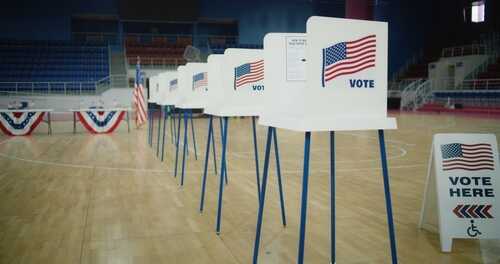
President Trump has announced that on August 31, 2025, he will issue an Executive Order mandating voter identification for every ballot cast, no exceptions.
At a Glance
- Trump declared on Truth Social that “Voter I.D. Must Be Part of Every Single Vote. NO EXCEPTIONS!”
- He also stated that mail‑in voting would be permitted only for the severely ill and military personnel stationed abroad
- The proposal joins earlier moves to phase out electronic voting, favoring paper ballots and hand counts instead
- Legal experts caution that presidential power likely does not extend to overruling state-managed election procedures
Context and Constitutional Reality
Trump’s announcement on August 31, 2025, via his Truth Social account, declared his intention to sign an Executive Order requiring voter ID for every vote cast, with no exceptions. He paired this with a mandate for paper ballots and restricting mail‑in voting to only the very ill and deployed military personnel.
Watch now: President Trump says he’ll sign executive order on voter ID · YouTube
However, the U.S. Constitution designates that states—and sometimes Congress—control the administration of elections, not the president. This has prompted widespread skepticism about whether such an order could be legally upheld.
Echoes of Earlier Orders and Legal Challenges
This move builds upon an executive order Trump issued in March 2025 requiring proof of citizenship when voting, which has already faced legal challenges and institutional criticism. Analysts warned that those without passports or enhanced documentation—potentially tens of millions—could be disenfranchised.
Additionally, Trump has previously launched efforts to downgrade electronic voting technologies in favor of paper ballots and hand counts, which officials argue are slower, more costly, and less accurate.
Alarming Strategy or Legal Overreach?
Critics, including Democrats and voting rights advocates, view this new initiative as an aggressive attempt to suppress voting and centralize election control. They see worrying parallels to historic voter suppression tactics.
Concurrently, states like California are positioning themselves to push back against such federal encroachments—California’s Secretary of State, Shirley Weber, in particular, has condemned these mandates as disenfranchising and inconsistent with the state’s voter access ethos.
Sources
Reuters
The Guardian
San Francisco Chronicle
Washington Post
Times of India