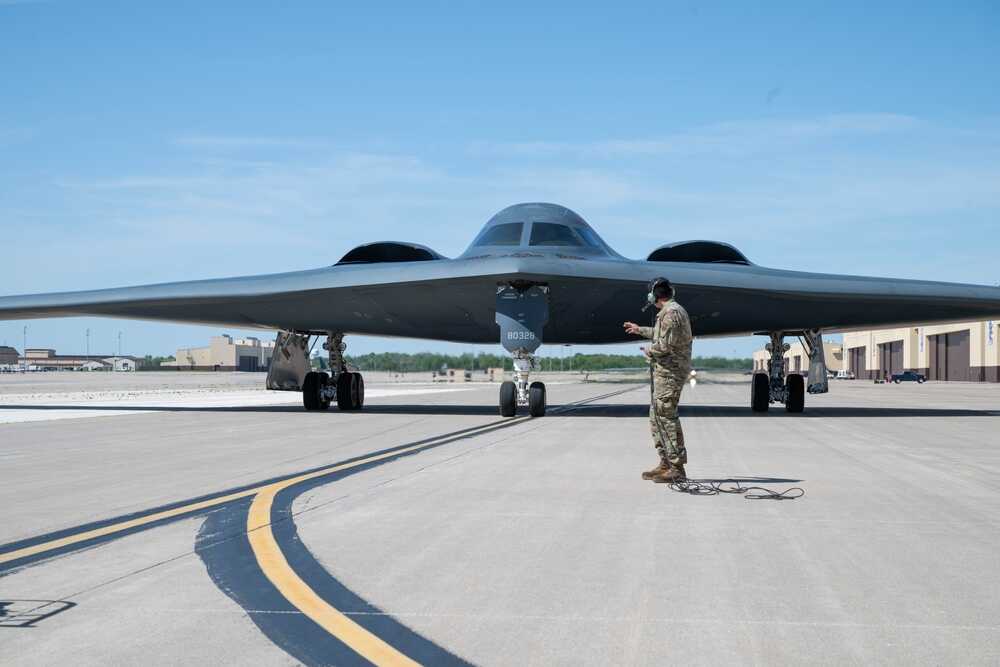
America’s own generals are warning that a fleet of just 100 B-21 Raider bombers could leave the United States exposed against China and Russia — and Congress is still dragging its feet.
Story Snapshot
- Top warfighters say the official plan for 100 B-21s is based on old threat assumptions and is not enough for real deterrence.
- Key defense leaders and studies now point to 145–200 B-21s as the minimum to handle China and Russia at the same time.
- The Air Force fact sheet still calls 100 the “minimum” inventory and leans on aging B-52s to fill the gap.
- Sticker shock and DC budget games risk underfunding the bomber fleet that protects American families and the homeland.
Top Commanders Say 100 Bombers Will Not Cut It
U.S. Strategic Command and Air Force Global Strike Command have both said that the 100‑plane B‑21 goal was built on threat assumptions that no longer match reality. These commands are the ones that must fight and win if China or Russia ever move from threat to attack. Their leaders warn that a fleet of 100 stealth bombers cannot provide strong day‑to‑day deterrence and also surge in a major war. They want policymakers to treat bomber numbers as a core part of national survival, not a line item to trim.
Senior Air Force voices have backed that warning for years. Former Global Strike commander Gen. Timothy Ray argued the United States needs about 225 bombers in total, including B‑21s and modern B‑52s, to meet national defense goals. Former Chief of Staff Gen. David Goldfein told Congress that a “moderate risk” force means 220 bombers, of which 145 would be B‑21s. These are not YouTube commentators. They are the people who have to send aircrews into harm’s way, and they are clear that 100 B‑21s will not be enough.
New Pentagon and Think Tank Math Points to 200 Raiders
Independent analysis is reinforcing what combat commanders see. A major report from the Mitchell Institute for Aerospace Studies in 2026 concluded that having fewer than 200 B‑21 bombers would leave the United States “dangerously exposed” in a high‑end war with China. The study explains that maintenance, training, and nuclear alert tasks mean only a fraction of bombers are ready to launch at any moment. With just 100 aircraft, the conventional bench is thin, making it harder to keep pressure on an enemy over weeks and months of conflict.
Earlier Pentagon assessments also pointed to higher numbers. Public reporting from these internal studies suggested the United States needed about 220 bombers overall, including around 145 B‑21s, as a baseline for a sustained global presence. Other research has gone further, calling for 200–288 B‑21s to keep America’s long‑range strike advantage as older aircraft retire and China rolls out its own H‑20 stealth bomber. For conservative readers who care about peace through strength, the pattern is clear: every serious look at the math pushes the required bomber count up, not down.
Official Program Stuck at 100 While Costs Are Weaponized
The Air Force’s own fact sheet still lists a “minimum of 100 aircraft” for the B‑21 program of record. It also says the B‑21 will “form the backbone” of the future bomber force together with B‑52s. That language sounds reassuring, but it locks in a low number that many commanders now believe is risky. It also leans on B‑52s that first flew in the 1950s and must survive in an age of advanced Chinese and Russian air defenses. The danger is that patriotic branding hides a real capacity gap.
Opponents of expansion are leaning hard on cost. Estimates put the price per aircraft around $700 million, with at least 100 bombers adding up to tens of billions of dollars over time. Some fiscal conservatives in Washington wave those numbers as proof that buying more than 100 is “unaffordable.” Yet the same leaders often voted for trillion‑dollar spending packages on non‑defense projects. For families who care about national security, the question is simple: is it really “too expensive” to build enough bombers to stop a war with China before it starts?
Trump Team Signals Support, but Congress Still Slow
Defense Secretary Pete Hegseth has broken from the old 100‑bomber script. He told the Senate Armed Services Committee that the United States will need “a lot more” than 100 B‑21s, sending a clear signal from the Trump administration that expansion is on the table. Admiral John “Jay” Paparo, who led United States Indo‑Pacific Command, testified that a force of 200 B‑21s would give the United States the penetrating strike and nuclear deterrence it needs in the Pacific. These are the voices on the front line of a possible showdown with Beijing.
🧐 🇺🇸🇨🇳🇷🇺 The stealth bomber race may already be over
China is developing the H-20.
Russia has spent years discussing and developing its future PAK DA bomber.
But here's the reality:
The United States fielded the Northrop B-2 Spirit decades ago, and it remains the world's… pic.twitter.com/8PPYoF4ul8
— Defence Index (@Defence_Index) July 4, 2026
Despite those warnings, Congress has not yet moved funding to buy more than 100 aircraft. Defense media and some Pentagon statements keep framing the 100‑bomber plan as “sufficient,” which makes expansion advocates sound alarmist or wasteful. Content that calls for 200 B‑21s often gets buried by social media algorithms favoring “neutral” or official narratives. For conservative readers, this looks like the same old story: the people charged with winning wars want the tools to do it, but the political and media class slow‑walk the response until it is too late.
Why This Matters to Every American Household
Long‑range bombers are not an abstract toy for generals. They are the aircraft that keep Chinese or Russian planners awake at night, because they can reach any target on the planet. When that threat is strong, dictators think twice before risking a war that could reach their own missile bases, command bunkers, and shipyards. When bomber numbers are thin, those regimes may start to believe they can punch through and get away with it. Deterrence works best when the enemy sees a large, survivable force, not a small one stretched thin.
Past decisions to retire two‑thirds of America’s bomber fleet already shrank our long‑range strike power. Now the United States stands at another crossroads. Either we build a B‑21 fleet measured in hundreds and keep the peace through strength, or we accept a minimalist 100‑bomber plan and hope our enemies stay impressed. For conservatives who value the Constitution, strong defense, and protection of American families, the math on the B‑21 Raider should be a wake‑up call: underbuilding this bomber is not “saving money,” it is gambling with national survival.
Sources:
19fortyfive.com, youtube.com, airandspaceforces.com, facebook.com, af.mil, reddit.com, simpleflying.com