

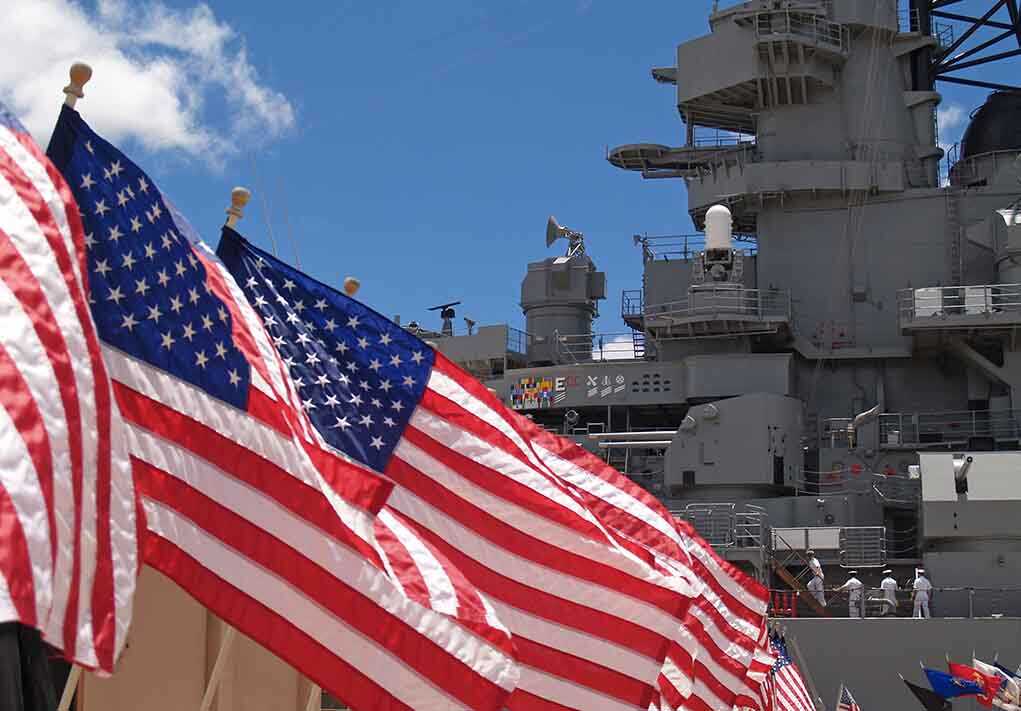
Four Iowa-class battleships carried 36 giant guns into World War II, yet none ever fired at an enemy battleship.
Story Highlights
- Navy records show Iowa-class ships screened carriers and bombarded shores, not enemy battleships.
- Fast design let the class run with carriers as warfare shifted to air power.
- Major actions included the Philippine Sea and Leyte Gulf, without battleship duels.
- The class proved value in Korea and later service through heavy fire support.
What The Navy’s Own Records Say About Iowa’s Combat Role
Naval History and Heritage Command records detail how USS Iowa entered service in 1943, first in the Atlantic, then in the Pacific. The ship’s official history lists raids on Japanese facilities, support for Marianas and Palau campaigns, and participation in the Battles of the Philippine Sea and Leyte Gulf. Those records do not show any main-battery duel with an enemy battleship. They show carrier screening and shore bombardment were the core missions, which matched the war the Navy had to fight.
Maritime records outside the Navy echo that view. The Maritime Administration’s history notes Iowa’s shift to the Pacific and her bombardment of Kwajalein and Eniwetok to soften beaches for landings. That is a classic fire-support job. It used those sixteen-inch guns to pound land targets, not rival capital ships. This role did not waste the ship’s power; it used it where it mattered for victory. Carrier planes hunted ships at sea, while fast battleships guarded the flattops and hit hardened shore sites.
Why The Big-Gun Duel Never Came
Planners drew the Iowa class to be fast and heavily armed, able to chase Japanese capital ships and keep pace with carriers. But by 1943 and 1944, air power had become the fleet’s main punch. Carrier aviation found and sank enemy ships at ranges guns could not match. Analysts point to the decisive shift to carriers as the reason classic line-of-battle duels faded. Writers summarizing the class note the irony: built to outrun and outgun, the Iowas did their biggest work protecting carriers and striking ashore, not trading salvos with enemy battleships.
Campaign timelines show the closest brush with a battleship showdown came at Leyte Gulf. Iowa and New Jersey sped north after a decoy carrier force, while older U.S. battleships fought the last big-gun night action at Surigao Strait. That split left the Iowas far from any peer battleship target. The result was clear: the class never fired a main-battery round at a battleship. That was not failure; it was the product of a new kind of fleet fight shaped by scouting, air strikes, and speed across vast seas.
What The Ships Still Delivered In War And Beyond
The Iowa-class did not sit idle. They guarded the most valuable ships in the fleet and laid down brutal shore fire. They did so in World War II and again in Korea. Summaries of the class stress that these ships returned to service to blast coastal targets and support troops ashore. That fire support saved lives and broke strongpoints. Later, updates carried cruise missiles, marrying old steel with new reach, while the big guns remained a fearsome tool for strikes near shore.
Public histories add plain numbers to that story. They emphasize that none of the four ships—USS Iowa, USS New Jersey, USS Missouri, and USS Wisconsin—ever dueled a Japanese battleship. Yet they screened fast carrier task forces, bombarded Japan’s home islands, and then fired hundreds of rounds in Korea. That record shows how doctrine, not design alone, decides a ship’s fight. The big guns stayed ready, but the mission set the target: air cover and land attack over ship-to-ship gun duels.
What This Means For U.S. Sea Power Today
Warfare changes. The Iowa story warns against judging force design by a single imagined duel. The Navy won by using each tool where it worked best. Fast battleships protected carriers and slammed shore targets. Carriers reached out to strike ships and airfields first. That mix beat a brutal enemy across the Pacific. Modern planners face the same test: match platforms to the fight, cut waste, and keep lethal options ready across long ranges.
For conservatives who value strength, the lesson is simple. Peace comes from power, skill, and wise use of taxpayer dollars. The Iowa-class did not need a photo finish with an enemy battleship to prove worth. They helped win the war by doing the jobs that mattered. Today, that means backing a Navy that fields speed, reach, and hard punch—without chasing flashy myths. Use what wins, protect the force, and keep America’s edge where our enemies least expect it.
Sources:
19fortyfive.com, history.navy.mil, ground.news, ww2db.com