

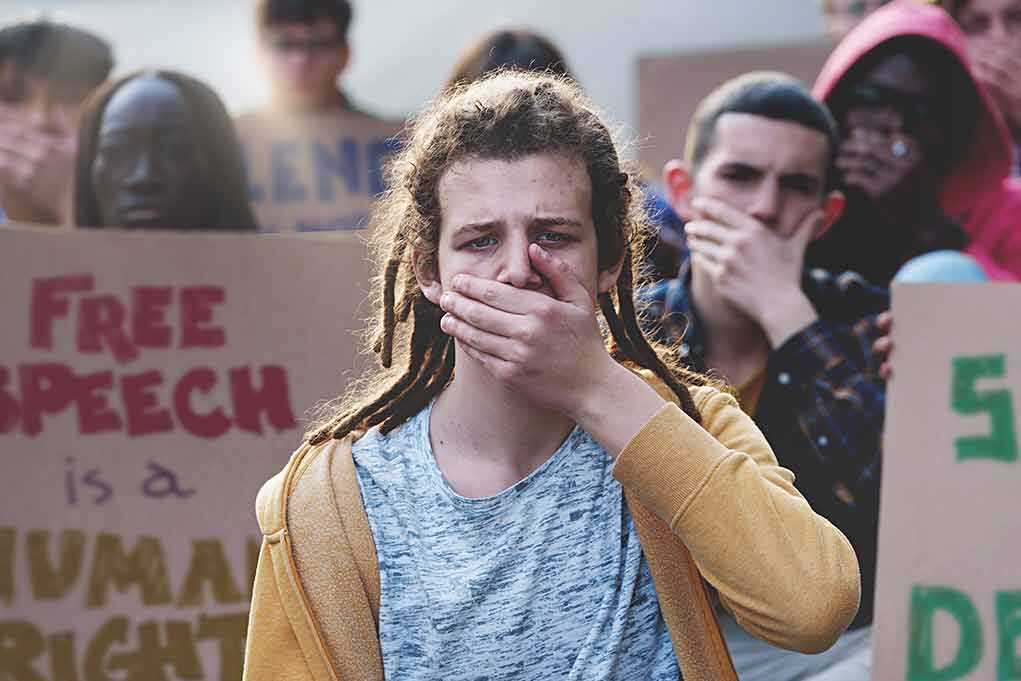
Three in ten college students now say violence can be acceptable to stop a campus speaker, putting free speech — and the rule of law — on the line.
Story Highlights
- FIRE’s new survey says 30% of students accept violence to stop a campus speech at least “rarely.”
- The detailed breakdown shows 2% “always,” 13% “sometimes,” and 19% “rarely,” with 66% “never.”
- The 2025 survey showed a similar pattern, giving the concern multi-year support.
- USA Today reporting confirms the 30% figure and notes movement from last year.
Survey Finding: A Concerning Tolerance for Force
The Foundation for Individual Rights and Expression reported that 30% of college students say using violence to stop someone from speaking on campus is acceptable at least in rare cases. The responses split into 2% “always,” 13% “sometimes,” 19% “rarely,” and 66% “never,” offering a clear look at student attitudes today. The same survey shows record-high acceptance for shouting down or blocking entry, placing physical disruption and force on the menu of campus tactics again.
USA Today described the 2026 figure as nearly one-third, and noted it shifted from the prior year’s level. That outside confirmation matters because it shows the claim is not stuck in a single group’s echo chamber. This is not about one splashy headline. It is about a steady share of students who now treat violence as an option, even if only in rare cases. That mindset risks chilling speech and inviting chaos when controversial voices arrive.
Trend Context: The Problem Did Not Start This Year
The 2025 College Free Speech Rankings found about a third of students endorsed violence at least rarely, up from the prior years. That shows this is not a blip tied to one campus or one news cycle. The item has been asked with clear categories for several years, so the concern is trackable and specific. A Cornell spotlight even echoed the same pattern at the campus level, underscoring that this attitude shows up in institution reports as well.
Critics may argue that “rarely acceptable” is softer than “always” or “sometimes.” That is true, and it should be stated clearly. But “rarely acceptable” still crosses a bright line. In the United States, we resolve ideas with more speech, not fists. The First Amendment tradition protects peaceful protest and counterspeech. It does not bless violence to silence opponents. Students can and should protest, but they must not trade debate for force.
Why This Matters: Free Speech Is a Guardrail, Not a Slogan
Conservative, liberal, or neither, every American has a stake in the right to speak. When students say violence might be okay to stop speech, they put all views at risk. That ends with only the loudest or most aggressive voices winning. Families send kids to college to learn, not to fear. Schools that shrug at intimidation signal that rules are optional. That harms safety, learning, and trust in the promise that ideas win on merit, not muscle.
President Trump’s administration has stressed law and order on campuses. That line means defending peaceful protest and enforcing rules against threats and force. Colleges that fail to protect speakers and listeners fail their mission. Donors, alumni, and parents should demand policies that are known, fair, and enforced. Clear penalties for disruption and violence help keep events open to all viewpoints and protect students who come to listen and ask hard questions.
Addressing Pushback: Protest Rights Without Excusing Violence
Some legal scholars say counterspeech, including tough heckling, can be protected speech. That tradition is real and valuable. But it stops where force, threats, or targeted shutdowns begin. When a shout becomes a blockade or a fist, the protection ends. Survey critics also note that many students rate their schools as doing a good job on speech. That view may be sincere, but it does not erase the 30% who green-light violence at least sometimes. Both facts can be true.
IOWA CITY, Iowa – The University of Iowa just collected another D- grade from FIRE’s College Free Speech Rankings, scoring a very poor 62 out of 100, and falling 42 spots to 105th of 261 schools in recent years.
That is the same failing letter as last year, when the score sat at… pic.twitter.com/nXzxD2cMY7
— Iowa First Media (@IowaFirstMedia) September 15, 2026
Method limits also matter. A survey is not a police log. It tracks attitudes, not acts. But attitudes guide choices. If one in three students now see violence as an option, campus leaders must lower the temperature before next semester’s flashpoint. That means firm security plans for events, equal access for speakers across views, training for staff on de-escalation, and fast consequences when lines are crossed. Peaceful protest stays welcome. Violence does not.
What Comes Next: Practical Steps to Restore a Culture of Debate
Colleges should adopt clear event policies that protect speech and protest zones, with time, place, and manner rules that are viewpoint-neutral. Schools should publish penalties for blocking doors, storming stages, or using force, and then follow through. Student groups should pre-plan with security, agree on ground rules, and know the costs for breaking them. Leaders should restate a simple principle on day one: In America, we answer speech with speech. Not with violence.